
Retreatment and post endo restoration with Overfibers post
16/01/2026
Francesca Cerutti
Warning: Undefined variable $post in /home/styleendo/htdocs/styleitaliano-endodontics.org/wp-content/plugins/oxygen/component-framework/components/classes/code-block.class.php(133) : eval()'d code on line 2
Warning: Attempt to read property "ID" on null in /home/styleendo/htdocs/styleitaliano-endodontics.org/wp-content/plugins/oxygen/component-framework/components/classes/code-block.class.php(133) : eval()'d code on line 2
A patient came to my attention complaining about impossibility to chew on the right side of the mouth.
A defective restoration was found on the first upper molar, with a distal secondary decay. A decay was also present on the second upper molar.
The diagnosis was of apical periodontitis in a previously treated tooth (16) and in a tooth with necrotic pulp (17).
The treatment planning included the retreatment of tooth 16 and the endodontic treatment of tooth 17.
The first phase of the retreatment was the disassembling. The existing crown was cut and removed, then the PRS kit was used to remove the cast post.
After that, rotary files dedicated to retreatment were used to remove the gutta percha and shape the root canal system.
Irrigation was done with NaOCl and EDTA, activated by ultrasonic K-files.
The obturation was done with hydraulic sealer and gutta percha.
Considering the residual tooth structure and the previous presence of a cast post, it was decided to position a glass fiber reinforced composite posts in the palatal root.
A dedicated bur was used to partially remove the gutta percha to create a post space; then, it was time to choose the post.
Considering the shape of the post space, I chose to restore the tooth with a Hi-Rem Post (Overfibers). Hi-Rem Post has high flexure resistance (1500 Mpa) and high and balanced flexure elastic modulus 60 GPa, moreover its rough surface promotes its adhesion to the luting composite, resulting in a high microtensile bond strength.
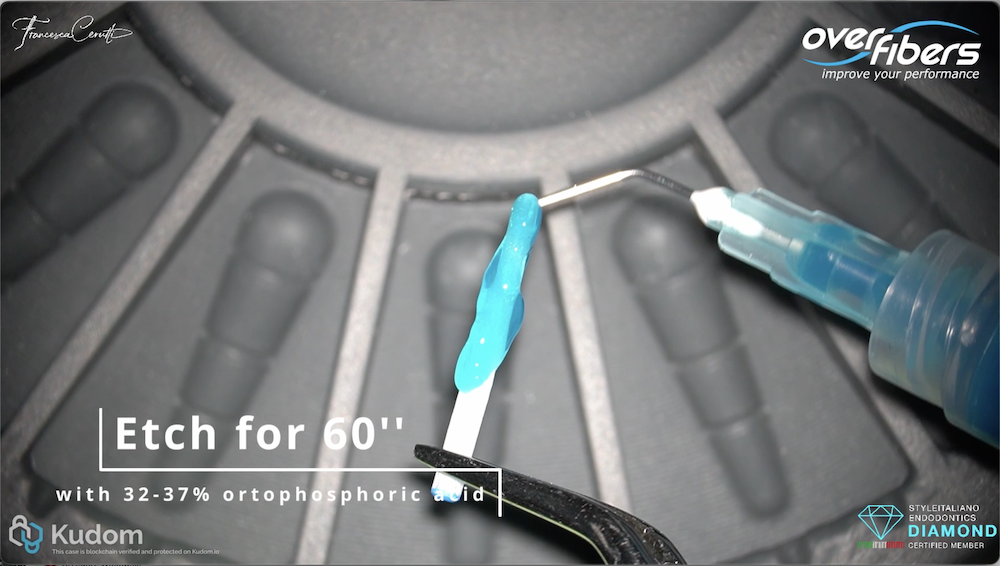
The largest post that passively fit into the root canal, was selected and cut at the desired length. The only treatment needed for this post is to etch with orthophosphoric acid for 60'', rinse and dry.
After this, with no need to treat the canal, a self adhesive luting composite, OverCem SA, was used in the Translucent shade. OverCem SA is a dual-cure self-adhesive luting material that perfectly bonds with the rough surface of Hi-Rem Post.
After bleeding the syringe, the dedicated tip is mounted and the first drop go composite is extruded and discarded. Subsequently, the composite is slowly injected into the post space and the post is positioned. Then, the assistant light cures.
After this passage, one is free to do the build up with one's favorite material.
Conclusions
The post endodontic X-ray shows a good adaptation of the post to the post space and the post is clearly visible thanks to its excellent radiopacity, more than 3 mm of aluminum.
The mechanical propertied of Hi-Rem Posts make them a good option for the restoration of crown less teeth.
Bibliography
1. Acquaviva P, Madini L, Krokidis A, Gagliani M, Mangani F, Cerutti A. Adhesive restoration of endodontically treated premolars: influence of posts on cuspal deflection. J Adhes Dent. 2011;13(3):279-85.
2. Akman S, Akman M, Eskitascioglu G, Belli S. Influence of several fibre-reinforced composite restoration techniques on cusp movement and fracture strength of molar teeth. Int Endod J. 2011;44(5):407-15.
3. Carvalho MA, Lazari PC, Gresnigt M, Del Bel Cury AA, Magne P. Current options concerning the endodontically-treated teeth restoration with the adhesive approach. Braz Oral Res. 2018;32(suppl 1):e74.
4. Figueiredo FE, Martins-Filho PR, Faria ESAL. Do metal post-retained restorations result in more root fractures than fiber post-retained restorations? A systematic review and meta-analysis. J Endod. 2015;41(3):309-16.
5. Guldener KA, Lanzrein CL, Siegrist Guldener BE, Lang NP, Ramseier CA, Salvi GE. Long-term Clinical Outcomes of Endodontically Treated Teeth Restored with or without Fiber Post-retained Single-unit Restorations. J Endod. 2017;43(2):188-93.