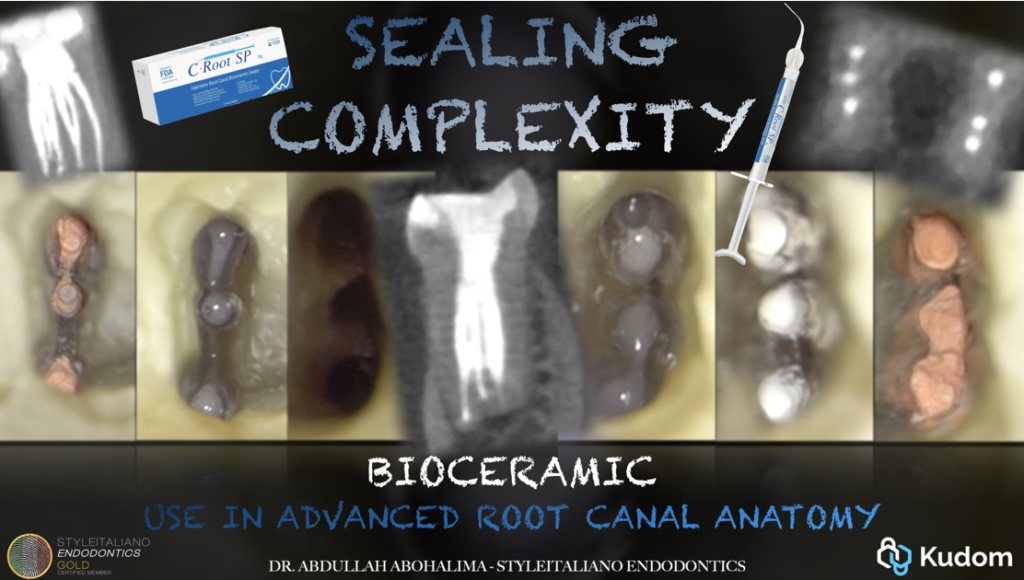
SEALING COMPLEXITY. Bioceramic use in Advanced Root Canal Anatomy. A true Middle Mesial & Middle Distal Canals Management!.
13/12/2025
Abdullah AboHalima
Warning: Undefined variable $post in /home/styleendo/htdocs/styleitaliano-endodontics.org/wp-content/plugins/oxygen/component-framework/components/classes/code-block.class.php(133) : eval()'d code on line 2
Warning: Attempt to read property "ID" on null in /home/styleendo/htdocs/styleitaliano-endodontics.org/wp-content/plugins/oxygen/component-framework/components/classes/code-block.class.php(133) : eval()'d code on line 2
Complexity in root canal anatomy remains one of the most challenging aspects of modern endodontic practice. While mandibular first molars are traditionally described as having two mesial canals (mesiobuccal and mesiolingual) and one or two distal canals, emerging evidence continues to highlight the presence of additional hidden canals that significantly affect treatment outcome when left undetected.
Among the most elusive anatomical variations are the middle mesial and middle distal canals. These canals are often narrow and deeply embedded within the dentinal map of the root, making them extremely difficult to identify without enhanced magnification, illumination, and advanced diagnostic tools.
The middle mesial canal is typically located between the mesiobuccal and mesiolingual canals and may present as a fin, confluent canal, or an independent canal with its own apical foramen.
Different studies have reported the prevalence of the middle mesial canal in mandibular first molars to range between 1% and 15%, with significantly higher detection rates achieved when using magnification and CBCT imaging.
On the other hand, the middle istal canal is even less frequently reported, with a prevalence estimated between 0.2% and 3%. When present, it is often extremely narrow and may join one of the main distal canals or exit independently.
These additional canals are clinically significant because failure to identify and adequately treat them has a direct correlation with persistent periapical pathology and eventual treatment failure.
The introduction of bioceramic materials has reshaped the landscape of endodontic obturation, offering superior sealing ability, biocompatibility, and chemical bonding to dentin. These characteristics provide a significant advantage when managing complex anatomy, particularly in cases where conventional techniques risk incomplete sealing or failure.
This article presents a clinical case of a mandibular first molar exhibiting both middle mesial and middle distal canals and highlights the role of BIOCERAMIC SEALER in managing and sealing such a highly complex anatomical configuration.
This case was referred to me due to a failed direct pulp capping.
CBCT scans demonstrated a highly complex canal configuration:
•Mesial root: three distinct canals (mesiobuccal, mesiolingual, and middle mesial)
•Distal root: three canals (distobuccal, distolingual, and middle distal)
This complex anatomy was the main reason for the referral.
Starting with access cavity preparation, followed by removal of the pulp stone.
The access cavity was then modified using ultrasonic tips to enhance visualization and precision.
Coronal flaring was performed to eliminate inflamed tissue from the main canal and to achieve optimal straight-line access for better file control.
This video illustrates the troughing procedure that performed at a 3 mm sub-pulpal level within the mesial root system to identify the presence of a middle mesial canal.
Once the canal orifice was detected, negotiation was carefully continued using a size 08 K-file, followed by the establishment of a glide path and subsequent progression toward full instrumentation.
During the instrumentation of the middle mesial canal, extreme caution is required due to its characteristically narrow and delicate anatomy.
In this case, instrumentation was limited to a size 20, 0.04 taper.
Troughing and shaping of the Middle Distal Canal were performed following the same approach and techniques applied in the mesial system.
Master Cone Fit Evaluation
Distal Root System:
A notably wide isthmus was observed in the distal root. Clinically, it appeared as if there were four canals, however, shifted radiographs confirmed the presence of three independent canals, each with a separate apical foramen.
Mesial Root System:
The mesial root similarly contained three independent canals. The configuration and number of canals were confirmed using shifted radiographs, ensuring precise anatomical identification.
Successful endodontic treatment in complex root canal systems relies on enhanced disinfection. Comprehensive irrigation, combined with activation using various techniques, improves irrigant penetration and effectively removes debris and microbial contaminants from the entire root canal system.
In this case, the Hydraulic Condensation Technique was performed using a C-ROOT bioceramic sealer.
This technique was chosen because the sealer can penetrate intricate anatomical regions that gutta-percha alone cannot reach, effectively filling anastomoses and intercanal communications, and providing predictable three-dimensional obturation.
The procedure commenced with the injection of the C-ROOT bioceramic sealer.
Although the three canals had separate apical foramina, the presence of multiple anastomoses and intercanal communications allowed the sealer to flow through these pathways, resulting in a comprehensive 3D fill.
Obturation and immediate coronal seal
The final obturation demonstrated an impressive anatomical reproduction, with three canals fully obturated in the mesial root and three canals fully obturated in the distal root.
All intercanal communications and anastomoses were completely filled, resulting in a clear three-dimensional (3D) obturation pattern achieved using the C-Root bioceramic sealer alone.
The three-dimensional CBCT provided comprehensive visualization of the root canal system.
This favorable outcome was achieved using a technique that is simple, efficient, and does not require specialized equipment, yet reliably produced an optimal three-dimensional (3D) fill in a highly complex root canal anatomy.
Long-term success relies not only on optimal apical sealing of all canals, but equally on a durable coronal seal achieved through conservative preparation, accurate cementation, and proper functional restoration.
By addressing both aspects, the treatment outcome is optimized in terms of sealing ability, biomechanics, function, and long-term clinical prognosis.
Conclusions
This article highlights that even highly complex root canal systems, with multiple canals and intercanal communications, can be predictably managed when meticulous identification, thorough cleaning, and careful instrumentation are applied.
The use of C-ROOT bioceramic sealer was pivotal, not only for its ability to flow into complex anatomical intricacies and achieve true three-dimensional obturation, but also for its bioactivity, chemical adhesion to dentin, dimensional stability, and capacity to set in moist environments, all of which contribute to an enhanced apical seal and long-term clinical success.
Bibliography
- Schilder H. Filling the root canal in three dimensions. Dent Clin North Am.1967;November:723–44.
- Debelian G, Trope M. The use of premixed bioceramic materials in endodontics. G Ital Endod. 2016; 30: 70–80.
- M. A. Versiani, R. Ordinola-Zapata, A. Keleş et al., “Middle mesial canals in mandibular first molars: a micro-CT study in different populations,” Archives of Oral Biology, vol. 61, pp. 130–137, 2016.
- H. H. Pomeranz, D. L. Eidelman, and M. G. Goldberg, “Treatment considerations of the middle mesial canal of mandibular first and second molars,” Journal of Endodontics, vol. 7, no. 12, pp. 565–568, 1981.
- K. Gulabivala, T. H. Aung, A. Alavi, and Y. L. Ng, “Root and canal morphology of Burmese mandibular molars,” International Endodontic Journal, vol. 34, no. 5, pp. 359–370, 2001
- Akbarzadeh N, Aminoshariae A, Khalighinejad N, et al: The association between the anatomic landmarks of the pulp chamber floor and the prevalence of middle mesial canals in mandibular first molars: An in vivo analysis, J Endod 2017;43: 1797.
- Al-Haddad A, Ab Aziz C, Zeti A (2016) Bioceramic-based root canal sealers: a review. International Journal of Biomaterials, 2016.