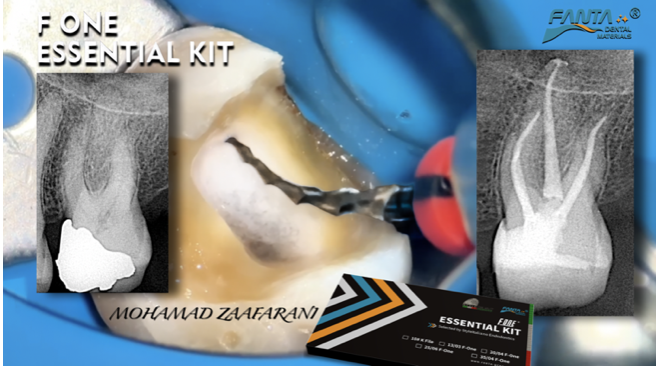
Maxillary Molar and F One Essential Kit
16/02/2026
Warning: Undefined variable $post in /home/styleendo/htdocs/styleitaliano-endodontics.org/wp-content/plugins/oxygen/component-framework/components/classes/code-block.class.php(133) : eval()'d code on line 2
Warning: Attempt to read property "ID" on null in /home/styleendo/htdocs/styleitaliano-endodontics.org/wp-content/plugins/oxygen/component-framework/components/classes/code-block.class.php(133) : eval()'d code on line 2
Shaping narrow and curved canals continues to represent one of the most demanding aspects of endodontic treatment, especially in the presence of coronal calcification.
Such complex anatomy significantly increases the likelihood of procedural complications, including ledge formation, canal transportation, and instrument fracture.
Successful management of these cases requires a carefully structured treatment strategy supported by instruments designed to balance flexibility, mechanical resistance, and clinical safety.
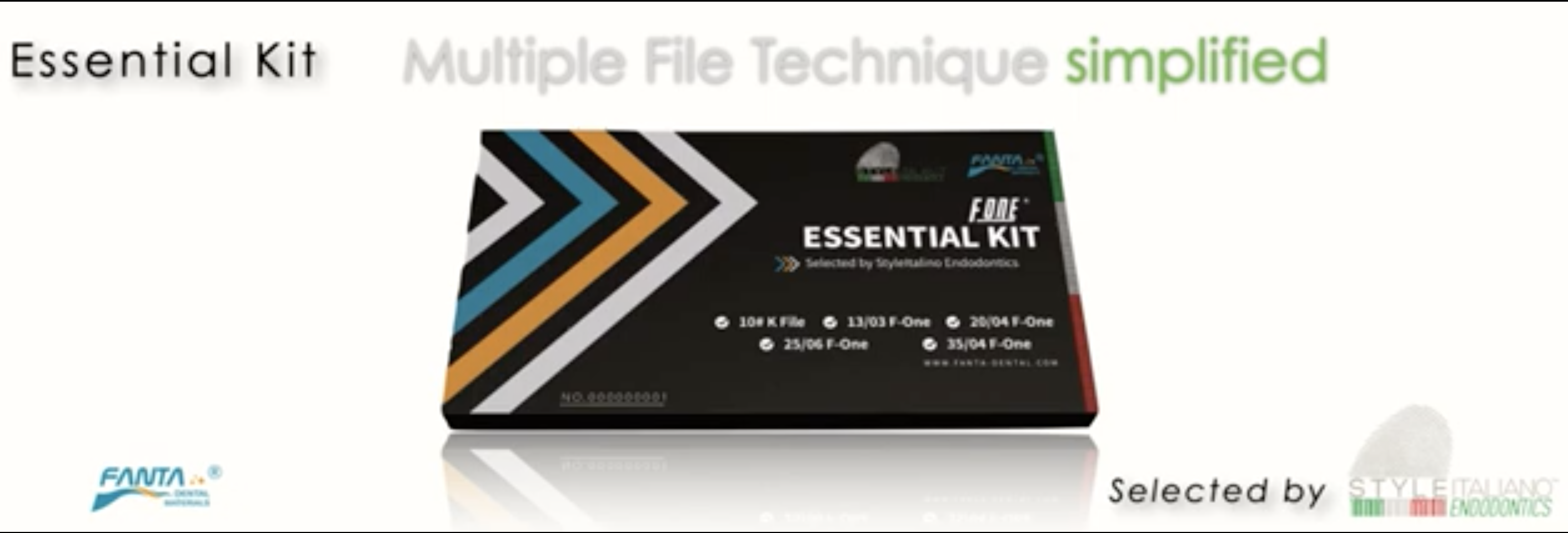
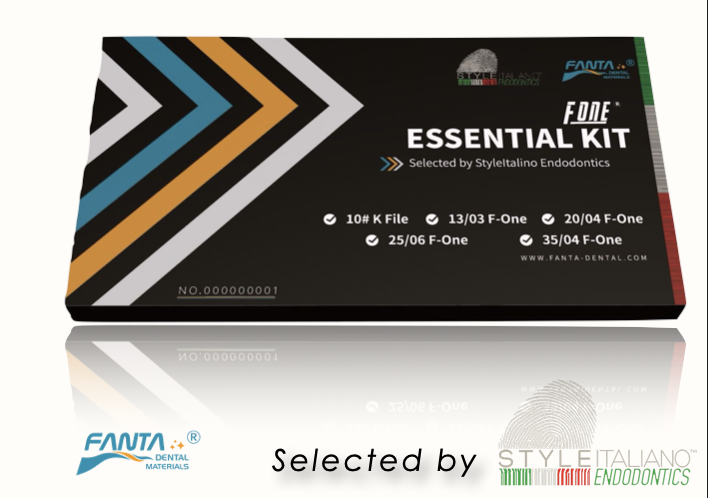
In this case, we demonstrate the management of a challenging root canal system using the F1 Essential Kit developed by SIE in cooperation with Fanta Dental, which was specifically developed to simplify complex shaping scenarios.
The system’s optimized design philosophy combining controlled cutting efficiency, a safe non-cutting tip, and advanced hybrid heat treated alloy and flat surface design allows for predictable canal negotiation while preserving the original anatomy and reducing procedural risks.
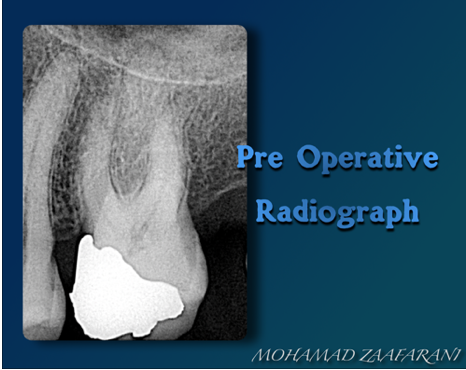
Fig. 1
Preoperative radiograph
preoperative diagnostic imaging of the referred case of maxillary molar. The periapical radiograph shows the possible obliteration of the pulp chamber and extremely narrow canals
possible multiplanner curvature in DB canal
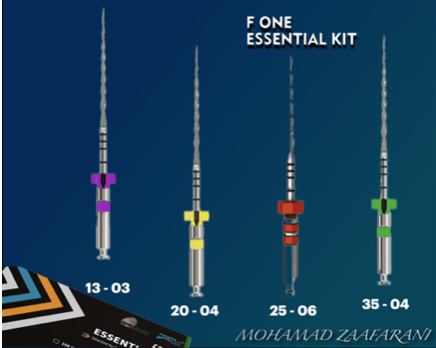
Fig. 2
The Essential kit as the system of choice:
The F one from Fanta Dental is a shaping system designed to simplify and enhance root canal preparation. It features a patented flat side design, which significantly reduces the contact area between the file and dentin, leading to lower torsional stress and improved safety during instrumentation. The file is manufactured from advanced AF-R heat treated NiTi alloy, providing superior flexibility and high resistance to cyclic fatigue, especially in curved canals.The essential kit is made based on the design of F one with hybrid heat treatment where the 13-03 is heat treatment with some austenitic features to keep some stiffness to enable penetration in initial phases of shaping and when it comes to larger sizes they are more flexible to maintain the canal geometry with less risk of mishaps
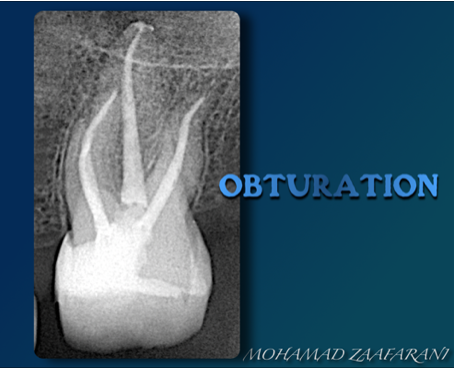
Fig. 3
Here is the final obturation radiograph following the sequence of essential kit where the 25-06 was used shortly limited to the coronal third for preflaing flooded by 13-03 for mechanical glide path.
MB and DB were shaped to size 25-06
MB2 shaped to 20-04
Palatal canal was shaped to size 35-04
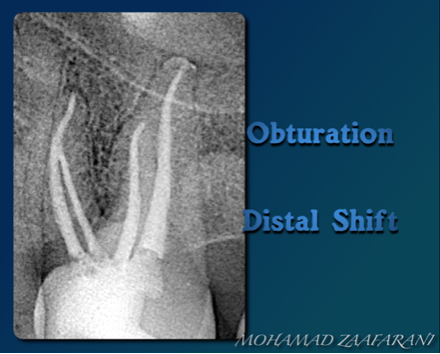
Fig. 4
Distal shift showing MB2 canal as a confluent system with MB canal in MB root.
Obturation done in modified heat technique using bio ceramic sealer and gutta percha.
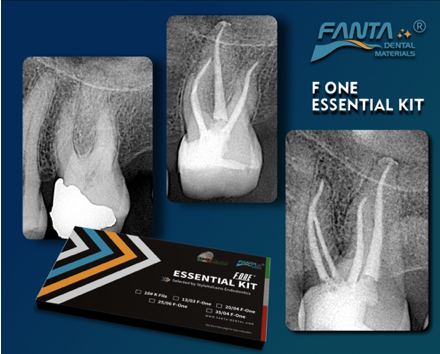
Fig. 5
Radiographic workflow
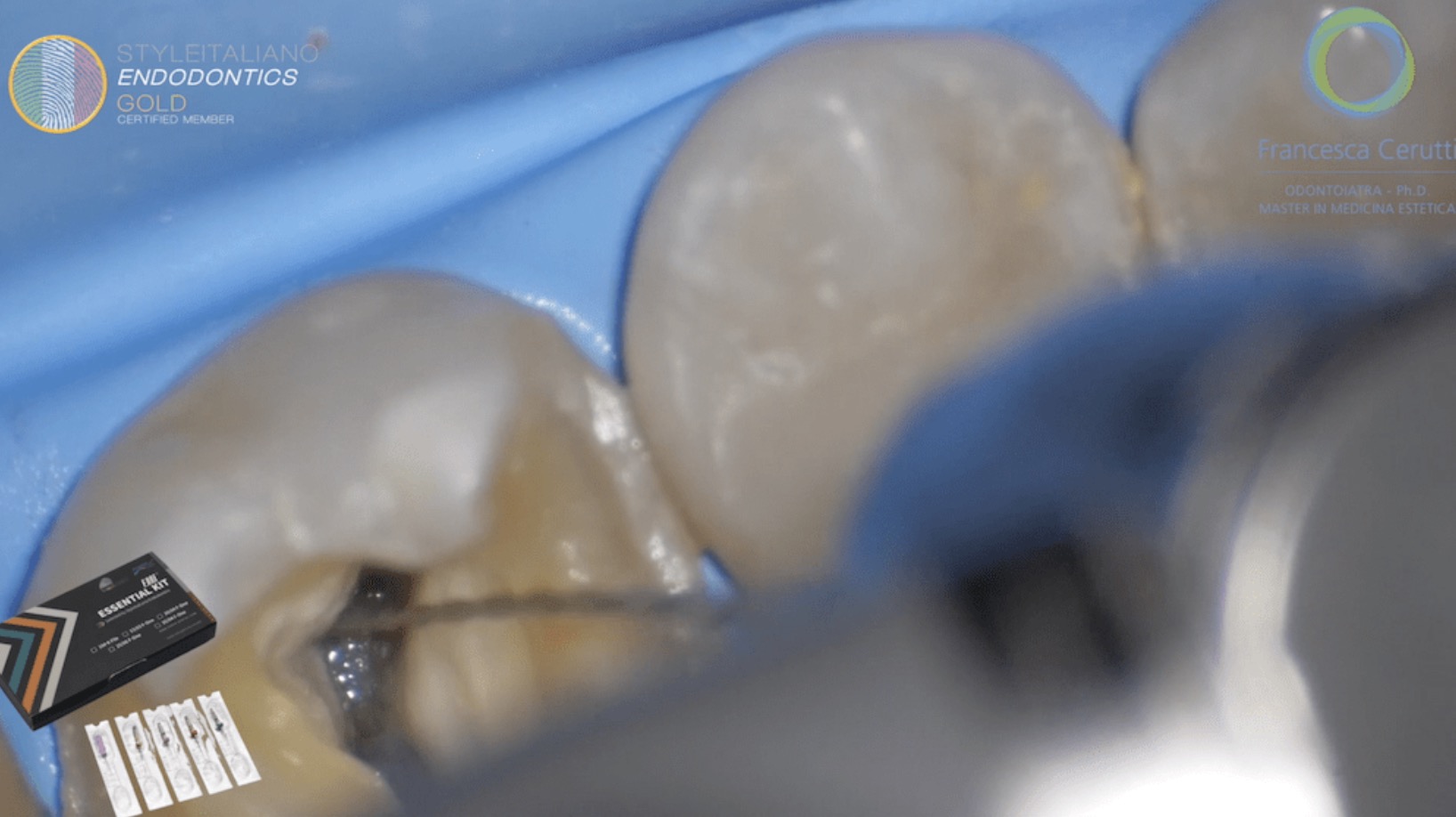
Video of the procedure
Conclusions
The Essential Kit has proven to be a versatile and clinically adaptable system capable of addressing a broad spectrum of root canal anatomies and treatment complexities. As demonstrated in this case, canals with regular anatomy can be predictably shaped to size 25/.06, achieving effective cleaning while maintaining structural integrity. In narrow canals, a more conservative approach by limiting preparation to size 20/.04. Conversely, in wider canals, controlled enlargement up to size 35/.04 can be performed to ensure adequate debridement without compromising canal anatomy.
A key strength of the Essential Kit lies in the flexibility of its shaping sequence when combined with the F1 design. The sequence can be strategically modified based on canal morphology, curvature, and overall case difficulty, allowing clinicians to tailor the instrumentation protocol to each individual case. This customizable approach enhances safety, preserves dentin, and supports predictable clinical outcomes, making the Essential Kit a reliable solution for both routine and challenging endodontic
Bibliography
- Cohen S, Hargreaves KM. Pathways of the Pulp. 9th ed. St. Louis, MO: Mosby Elsevier; 2006.
- Krasner P, Rankow HJ. Anatomy of the pulp chamber floor. J Endod. 2004;30(1):5–16.
- Trope M, Bunes A, Debelian G. Root filling materials and techniques: bioceramics—A new hope? Endod Topics. 2015;32:86–96.
- Shen Y, Qian W, Abtin H, Gao Y, Haapasalo M. Fatigue testing of controlled memory wire nickel-titanium rotary instruments. J Endod. 2011;37(7):997–1001. doi:10.1016/j.joen.2011.03.023
- West JD. Manual versus mechanical endodontic glide path. Dent Today. 2011;30(1):136, 138, 140.
- Plotino G, Nagendrababu V, Bukiet F, et al. Influence of negotiation, glide path, and preflaring procedures on root canal shaping—Terminology, basic concepts, and a systematic review. J Endod. 2020;46(6):707–729. doi:10.1016/j.joen.2020.01.023