Route to Apex
07/05/2026
Ibrahim El Naggar
Warning: Undefined variable $post in /home/styleendo/htdocs/styleitaliano-endodontics.org/wp-content/plugins/oxygen/component-framework/components/classes/code-block.class.php(133) : eval()'d code on line 2
Warning: Attempt to read property "ID" on null in /home/styleendo/htdocs/styleitaliano-endodontics.org/wp-content/plugins/oxygen/component-framework/components/classes/code-block.class.php(133) : eval()'d code on line 2
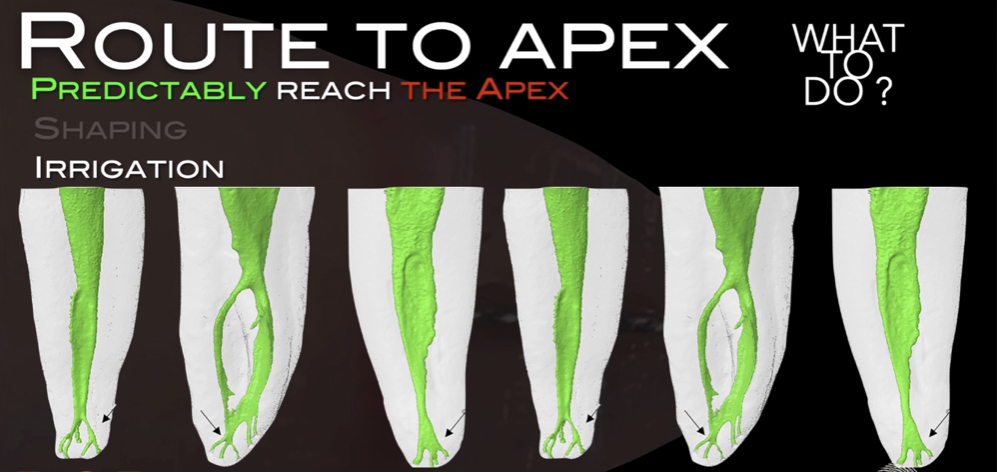
The process of the shaping is one of the most challenging , is the step that contain most of the errors so the clinician must know the most appropriate protocol for simplifying the shaping procedure in this video we are going to go through the step down technique which will be explained in the video.
Conclusions
The clinician must facilitate the process of the shaping using correct protocols , tools and techniques.
Bibliography
1. Schilder H. (1974). Cleaning and shaping the root canal. Dental Clinics of North America, 18(2):269–296.
2.Weine FS. (1982). Endodontic Therapy. 3rd Edition. Mosby.
3.Roane JB, Sabala CL, Duncanson MG. (1985). The “balanced force” concept for instrumentation of curved canals. Journal of Endodontics, 11(5):203–211.
4.Walia HM, Brantley WA, Gerstein H. (1988). An initial investigation of the bending and torsional properties of Nitinol root canal files. Journal of Endodontics, 14(7):346–351.
5.Bergmans L, Van Cleynenbreugel J, Wevers M, Lambrechts P. (2001). A methodology for quantitative evaluation of root canal instrumentation using microcomputed tomography. International Endodontic Journal, 34(5):390–398.
6.Peters OA, Schönenberger K, Laib A. (2001). Effects of four Ni-Ti preparation techniques on root canal geometry assessed by micro computed tomography. International Endodontic Journal, 34(3):221–230.
7.Peters OA. (2004). Current challenges and concepts in the preparation of root canal systems: A review. Journal of Endodontics, 30(8):559–567.
8.Peters OA, Arias A, Paqué F. (2010). Shaping and cleaning the root canal system: current technology, advanced concepts, and future trends. Endodontic Topics, 19(1):307–326.
9.Schneider SW. (1971). A comparison of canal preparations in straight and curved root canals. Oral Surgery, Oral Medicine, Oral Pathology, 32(2):271–275.